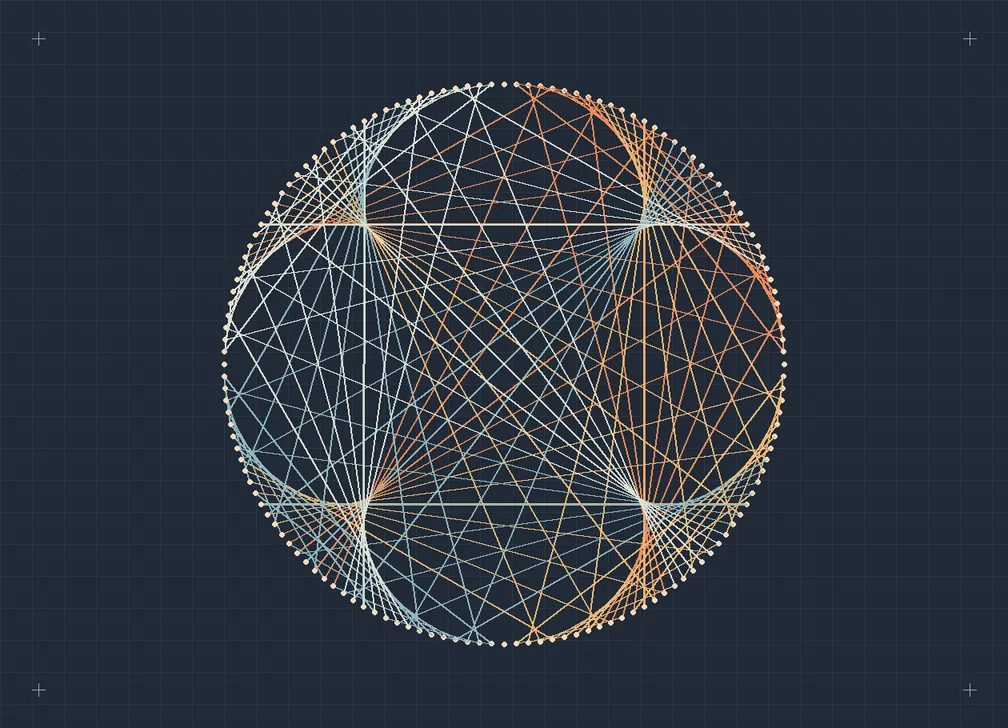
How to read the plate
Imagine placing 144 pins at equal intervals around a circle. Number them from zero. Starting at pin i, draw a straight thread to pin (i × m) modulo 144. Repeat that for every pin. Changing the multiplier m changes where each thread ends. The circumference and every pin stay in exactly the same place.
Try the three studies above. Follow one line all the way to its endpoint, then let your eye take in the whole sheet. The curved envelopes appear where many straight threads pass near one another. The four colours group consecutive sets of starting points so you can follow a section across the drawing. They play no part in calculating the endpoints.
What was in the art room
The historical page grouped some pieces under algorithmic work. Its index included numbered links with terra, tux and gira in their filenames. Elsewhere it linked to an Emacs graphic, writings and screenshots of Go played in an editor. A visitor could move from an image to a program in a single click. The current plate takes that relationship as its subject. Its geometry and palette were made for this edition.
To reproduce the exercise on paper, start with twelve evenly spaced marks and a multiplier of five. Pin two connects to pin ten. Pin three connects to pin three because fifteen leaves remainder three when divided by twelve. That last case draws no visible thread. It is a small reminder that a picture can hide a perfectly ordinary step in the rule that made it.
Make your own plate
Download the Python drawing source and run the command below with Python 3. It writes a vector drawing that opens in a browser. Try a multiplier of one to see what happens when every point connects to itself.
python chord-study.py 29 > study.svg